
Why the Nancy Grace Roman Space Telescope Matters

Quick Answer
NASA's Nancy Grace Roman Space Telescope is a new space observatory designed to give scientists a much wider view of the universe. It successfully launched on August 30, 2026, aboard a SpaceX Falcon Heavy and is now traveling toward its final orbit about one million miles from Earth. Once it begins science operations, Roman will study some of the biggest questions in astronomy, including dark energy, dark matter, exoplanets, and how galaxies form and evolve.
But Roman is about more than just taking incredible pictures of space. Its ability to survey enormous areas of the sky quickly could give scientists a completely different way to study the universe. So how did this telescope come to be, who was Nancy Grace Roman, and what could we actually learn from it?
Let's break it down.
Who Was Nancy Grace Roman?

Before understanding the telescope, it helps to understand the person it was named after.
Nancy Grace Roman was an astronomer and NASA's first Chief of Astronomy. Born in 1925, she developed an interest in astronomy when she was young and went on to earn a bachelor's degree in astronomy from Swarthmore College and a Ph.D. from the University of Chicago.
Roman joined NASA in 1959, only six months after the agency was created. At a time when women faced significant barriers in science, she became NASA's first female executive and played a major role in developing the agency's space-based astronomy program.
Her biggest legacy may be the Hubble Space Telescope.
Roman spent years helping convince NASA and Congress that a powerful telescope operating above Earth's atmosphere was worth the enormous investment. She brought scientists and engineers together, helped define the telescope's scientific goals, and worked to secure the support and funding needed to make the project happen.
Her efforts eventually helped turn the idea that became Hubble into reality, and now her mission is being continued with NASA's newest major space telescope. One that is named after her.
How Did the Roman Space Telescope Come to Be?
Roman wasn't originally called the Roman Space Telescope.
The mission was initially known as the Wide Field Infrared Survey Telescope, or WFIRST. NASA eventually renamed it in 2020 to honor Nancy Grace Roman and her role in establishing space-based astronomy as a major part of NASA's scientific work.
The basic idea behind the mission was simple: What if scientists could see a much larger portion of the universe at once?
Hubble has given us some of the most detailed images in astronomy, but its relatively narrow field of view means that surveying huge sections of the sky can take a long time.
Roman approaches the problem differently.
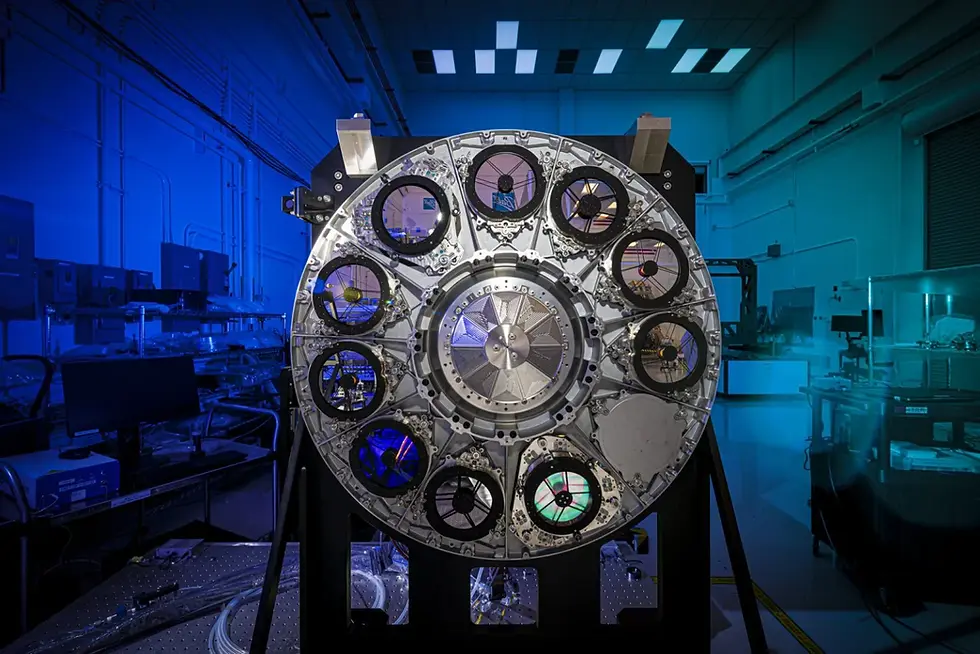
Its primary mirror is about the same size as Hubble's, but its Wide Field Instrument can see an area of sky at least 100 times larger in a single image through the 300-megapixel infrared camera. NASA estimates that Roman can survey the sky up to 1,000 times faster than Hubble while maintaining similar sensitivity and infrared resolution.
So instead of only looking closely at a small part of the universe, Roman can create enormous surveys of it.
And that's where its science gets really interesting.
What Will Roman Actually Study?
Roman has several major scientific goals, but three stand out: dark energy and dark matter, exoplanets, and the evolution of galaxies and other cosmic objects.
Dark Energy and Dark Matter:
We know that the universe is expanding, and that expansion is accelerating. Scientists call the mysterious cause of that acceleration dark energy.
Roman will help investigate whether dark energy has remained consistent throughout cosmic history or whether it has changed over time. It will do this by mapping enormous numbers of galaxies and measuring how matter is distributed throughout the universe.
Roman will also help scientists study dark matter, the invisible matter whose gravitational effects influence how galaxies and larger structures form.
The important part is scale.
Roman isn't going to solve these questions by looking at one galaxy at a time. It will survey huge portions of the universe and collect measurements from enormous numbers of galaxies, giving scientists a much larger dataset to work with.
Finding Thousands of New Worlds:
Roman will also change how we discover planets outside our solar system.
The telescope is expected to identify around 100,000 exoplanets using its observations, including planets that would be difficult to find using other methods. Its primary planet-hunting technique will be microlensing, which uses the bending of light caused by gravity to reveal planets around distant stars.
Roman's microlensing survey will be especially useful for finding planets farther from their stars, including worlds similar in some ways to the outer planets of our solar system and even rogue planets that do not orbit a star.
Understanding How Galaxies Change:
Roman will also look at galaxies across enormous stretches of cosmic history.
By observing billions of galaxies, scientists can investigate how galaxies formed, grew, and changed over time. Roman's observations will help researchers study everything from individual stars to massive galaxies and black holes.
And because Roman can repeatedly observe large areas of the sky, scientists can also catch objects that change over time.
Stars explode. Black holes grow. Objects brighten and fade.
Roman will be able to help astronomers find these changes across enormous areas of the universe.
Why Is Roman's Wide View So Important?
This might be the most important thing to understand about Roman.
Its biggest advantage isn't necessarily that it will produce prettier pictures than other telescopes.
It's that it can collect huge amounts of information about the universe.
NASA expects Roman to send back about 1.4 terabytes of data every day, making it the highest data-rate astrophysics mission NASA has launched so far. That information will be available for scientists to analyze across many different areas of astronomy.
And scientists don't necessarily have to know exactly what they're looking for before Roman launches.
A survey this large could reveal things researchers aren't expecting.
A new type of object. An unusual planetary system. A strange change in a distant galaxy. A pattern that doesn't match current theories.
What Makes Roman Different From Hubble and Webb?
Roman isn't replacing Hubble or the James Webb Space Telescope.
Instead, the three observatories can complement each other.
Hubble is known for its sharp images and decades of observations. Webb specializes in extremely sensitive infrared observations and can study very distant and faint objects in incredible detail.
Roman combines infrared capabilities with a much wider field of view.
Think of it this way:
Hubble and Webb can zoom in. Roman can step back and see the bigger picture.
That combination is extremely useful. Roman can identify interesting objects or patterns across huge areas of sky, while other telescopes can then study individual targets in greater detail.
Roman Has Already Launched. What's Next?
Roman successfully launched from NASA's Kennedy Space Center on August 30, 2026, at 7:26 a.m. EDT aboard a SpaceX Falcon Heavy. It separated from the rocket's second stage about 31 minutes later and began its journey toward the second Sun-Earth Lagrange point, or L2, about one million miles from Earth.

The telescope will spend about three months traveling to its final orbit while NASA teams deploy, test, and calibrate its instruments.
NASA expects Roman's first images in early 2027.
So the biggest discoveries are still ahead.
Frequently Asked Questions
Why is the telescope named after Nancy Grace Roman?
The telescope was named after Nancy Grace Roman, NASA's first Chief of Astronomy and a major advocate for space-based astronomy. Her work helped make the Hubble Space Telescope possible, earning her the nickname “mother of Hubble.”
When did the Roman Space Telescope launch?
Roman launched on August 30, 2026, aboard a SpaceX Falcon Heavy from NASA's Kennedy Space Center in Florida.
How is Roman different from Hubble?
Roman has a similar-sized primary mirror to Hubble but a field of view at least 100 times larger. This allows Roman to survey enormous areas of the sky much faster.
Will Roman look for aliens?
Roman isn't specifically designed to search for extraterrestrial life. However, its study of exoplanets will help scientists understand how common different types of planetary systems are and where planets are located throughout our galaxy.
When will we see Roman's first images?
NASA currently expects Roman's first images to be released in early 2027 after the telescope completes its commissioning process.
Keep Exploring Space
Want to learn more about the issues shaping the future of space?
Explore the Space Minds Center Articles for deeper discussions about space policy, commercialization, environmental concerns, and the challenges facing the next generation of space exploration:
Continue Learning with the Underline Space Roundtable
Interested in going beyond the headlines?
The Underline Space Roundtable Program brings together students interested in space policy, engineering, and current space missions for interactive discussions and collaborative learning.science, engineering, and current space missions for interactive discussions and collaborative learning.
The Roman Space Telescope is only beginning its journey. Over the next several years, its observations could change what we know about planets, galaxies, dark matter, dark energy, and the history of our universe.
And somewhere in all that data, there may be a discovery that changes the questions we ask next.
Keep exploring, keep asking questions, and keep looking beyond Earth.

Comments